Twenty-six lamps
An Enigma operator watched a lampboard instead of a printed page. Beneath its 26 letters sat a keyboard. Inside the military machine, an electrical path ran through the plugboard and the wired rotors to a reflector, then returned through the wheels and plugboard to light one letter. A receiving operator, using matching settings, could put the ciphertext through the same machine and recover the original text.
Arthur Scherbius patented an early rotor-machine design in 1918. Commercial Enigmas appeared during the following decade, before military purchasers adopted modified versions. Buying a commercial machine could reveal the general principle. Its wiring could not simply be assumed to match a German military Enigma, and the military plugboard introduced another set of letter exchanges.
A rotor connected 26 contacts on one face to 26 on the other in a scrambled order. Turning it brought a different contact into line with the incoming current. The right-hand wheel advanced before each letter was enciphered; turnover positions brought its neighbours into motion. Repeated presses of the same key passed through changing substitutions, rather than a single fixed letter exchange.
Operators also changed settings. Wheel order determined which rotor occupied each position. An adjustable index ring could turn relative to the wired core, while plugs exchanged pairs of letters before and after the rotor passage. Intercepting a radio message supplied the resulting letters. It did not supply the positions and connections that had produced them.
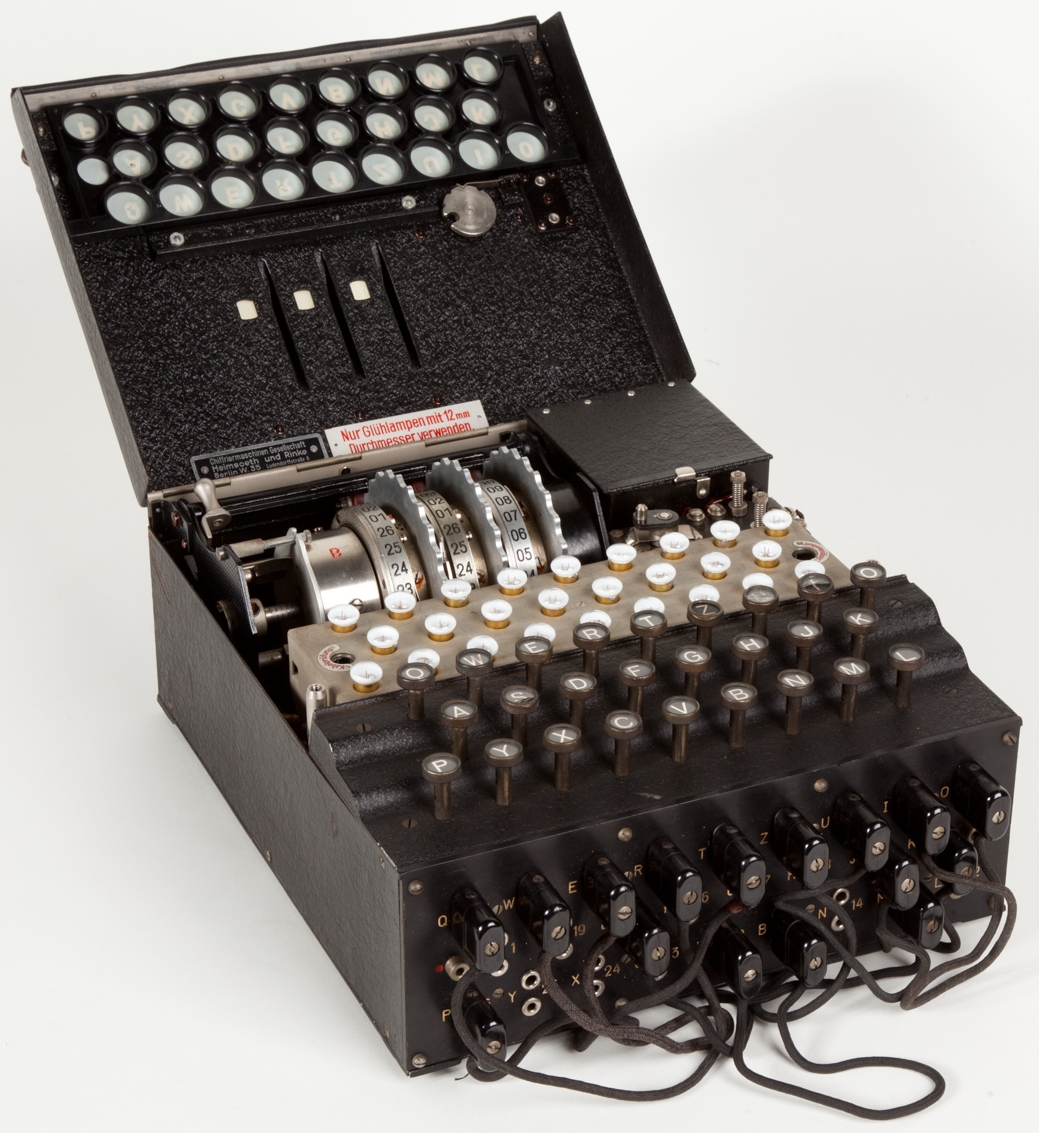
Enigma I in the Museo Nazionale della Scienza e della Tecnologia Leonardo da Vinci, Milan. Photograph from 2012; Commons version cropped by OS in 2016.
A course in Poznań
Polish military intelligence approached the University of Poznań in 1929 to recruit students for a secret cryptology course. Professor Zdzisław Krygowski helped identify candidates. Knowledge of German mattered in a city whose recent history had left many students familiar with the language used in the intercepted traffic.
Marian Rejewski studied mathematics at Poznań. Henryk Zygalski and Jerzy Różycki also emerged from the recruitment effort and eventually joined him in the Cipher Bureau’s German section. Their work belonged to an intelligence service concerned with communications across Poland’s western border. It required people who could treat changing letter substitutions as a mathematical problem and still work with the incomplete traffic arriving from interception stations.
The repeated message key offered a manageable starting point. A permutation is a rearrangement: each input letter has one corresponding output at a particular machine position. Rejewski could express the machine’s electrical passages as such rearrangements, then study the relationships visible when an operator enciphered the same key twice.
This approach separated questions that intercepted prose alone could blur together. The wiring inside a rotor was a lasting property of that component. A day’s plugboard connections and wheel settings could change. Recovering one did not automatically provide the others. Rejewski’s early success would depend on obtaining enough information to separate those unknowns.
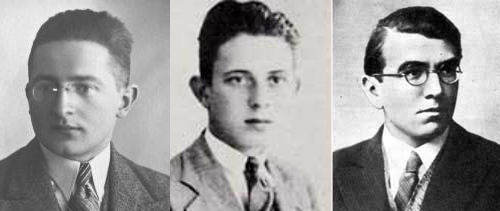
Marian Rejewski, Jerzy Różycki and Henryk Zygalski, from left. A later composite of period portraits, not a single group photograph.
Documents without the wires
French intelligence obtained material from Hans-Thilo Schmidt, a German employee with access to cipher documents. The channel handled by Gustave Bertrand supplied operating information and, later, key lists to the Polish service. These documents explained choices made by operators. They were not a complete set of drawings of the hidden rotor connections.
Key lists nevertheless removed some of the unknowns from Rejewski’s calculations. Knowing specified settings for particular days let him compare the rearrangements implied by intercepted indicators with the rearrangements a military Enigma had to contain. He reconstructed the rotor wiring around the turn of 1932–33. Polish engineers could then build machines that reproduced the military Enigma’s encipherment.
Both contributions were necessary to this particular sequence of events. A stolen instruction could identify how a message began without revealing how every electrical contact was connected. Mathematical work could extract those connections from the right evidence. The papers reached analysts equipped to use them.
A reconstructed Enigma still faced a fresh task each morning. German key instructions changed the settings under which the day’s traffic was sent. The Polish team had learned how the machine transformed a letter; they still needed ways to discover which settings the operators were using. That recurring work drove the development of further aids.
A catalogue that could expire
Under the earlier German procedure, operators used a common daily starting position to encipher their message keys. Each chosen three-letter key was entered twice. Across many intercepted headers, the first encrypted position could be related to the fourth, the second to the fifth, and the third to the sixth.
Rejewski examined the cycles formed by these relationships. The plugboard could relabel the letters in a cycle without changing its length. That gave the analysts a useful property to compare even when the actual plugged pairs were unknown. A catalogue could associate a pattern of cycle lengths with possible rotor arrangements.
The cyclometer helped compile that catalogue. It was an earlier Polish device with a different job from the Bomba. Its paired rotor groups generated the characteristics needed for the reference records; analysts then compared intercepted indicators against those records. Building the catalogue demanded extensive preliminary work.
A change to the reflector in November 1937 meant the records had to be made again. The wires inside that component altered the permutations on which the catalogue depended. An intercepted header could still look like the same sort of six-letter group while referring to a different electrical passage through the machine.
For the cryptanalysts, recovering a useful routine brought no promise that it would remain useful. German instructions and components could change independently. The next change would remove the shared starting position that made the catalogue comparison possible.
A different start for every message
On Sept. 15, 1938, a new indicating procedure changed the available evidence. For each message, an operator chose a starting position and transmitted it openly. The doubled message key was then enciphered from that position. Headers no longer shared the daily start on which the older catalogue method had relied.
One repetition remained. The plaintext entered at positions one and four was still the same letter. So was the plaintext at positions two and five. If the encrypted letters also happened to coincide across one of those gaps, the intercept contained a useful fixed point, historically called a “female.”
Equal ciphertext letters did not tell an interceptor the repeated plaintext letter. They did give a condition that a possible machine setting had to satisfy. Two copies of the Enigma’s rotor passage, placed three fast-wheel steps apart, could be tested for equal outputs from a selected input.
The indicator ADDAKS used in this exhibit has A in its first and fourth positions. It comes from David Link’s modern reconstruction, not a surviving interception log. Link generated it using a known historical key so that the reconstructed search could be checked. Its value here is experimental: the expected result is known, and the model can either reproduce it or fail.
Several suitable indicators were needed. The analysts sought coincidences at different relative positions, then arranged paired rotor sets to test those conditions together. An operating instruction intended to protect message keys had preserved a repeat that could be searched.
Six rotor sets above a motor
The Bomba brought six complete Enigma rotor sets into one electrically driven assembly. Each set contained three cipher wheels. Connected in pairs, the sets tested three repeated-letter conditions while a common drive moved through possible offsets. Rejewski devised the machine in 1938, and the Warsaw firm AVA built the Polish devices.
With three different rotors available, their possible orders numbered six. Each Bomba dealt with one order. Six machines could therefore cover the orders in parallel. For a fixed order, the three letter positions gave 26 × 26 × 26, or 17,576, combinations to examine. That count describes this particular search; it is not the total number of possible Enigma keys.
In Link’s reconstruction, the two rotor passages in a pair are separated by three positions on the fast wheel. The starts of the other pairs are offset to reflect the other intercepted headers. A common change then advances the search while preserving those relative differences. All three paired comparisons must agree before the machine produces a stop.
Rejewski’s later accounts put a complete run at about two hours. This exhibit can accelerate the same count, or step through it manually. The motor sound is an interpretation rather than a recording of an original Bomba. No original survives from which its sound could be recovered.
The wooden cabinet and metal finish follow a modern illustration based on a recollection sketch. Internal drive parts in the cutaway are illustrative. The tested electrical permutations are specified in the software; the reconstructed appearance carries a different level of certainty.
A stop still needed checking
A Bomba stop narrowed the work. It did not print a readable message. In the routine reconstructed here, the selected repeated letter must be unaffected by the unknown plugboard, and the six-letter indicator must avoid a turnover of the slower wheels. An unsuitable intercept can defeat those assumptions even when the underlying Enigma settings are real.
The three sample indicators produce several mathematical stops when all six rotor orders are tried. With the example’s known plugboard, only order II–I–III and ring setting ZWD pass the full check. The historical indicator HCALNU, sent from starting position FRX, then deciphers to AGIAGI. The repeated key is visible again.
Link’s work supplies an explicit, reproducible account of this process. The surviving descriptions do not establish every detail of the original circuitry. Keeping the reconstruction identifiable allows the reader to test its result without mistaking a later engineering choice for a documented 1938 component.
Zygalski developed a separate aid using perforated sheets. Patterns of holes recorded positions at which useful coincidences could occur; superimposing appropriately shifted sheets reduced the possible settings. This method used the repeated-key weakness through a different procedure from the motor-driven Bomba.
Modern displays can conceal gaps in the record by looking complete. Science Museum researchers found no surviving original Zygalski sheets or contemporary pictures of them. The photograph reproduced here shows a later demonstration. Its holes make the principle visible, while the caption keeps the date of the demonstration separate from the date of the invention.
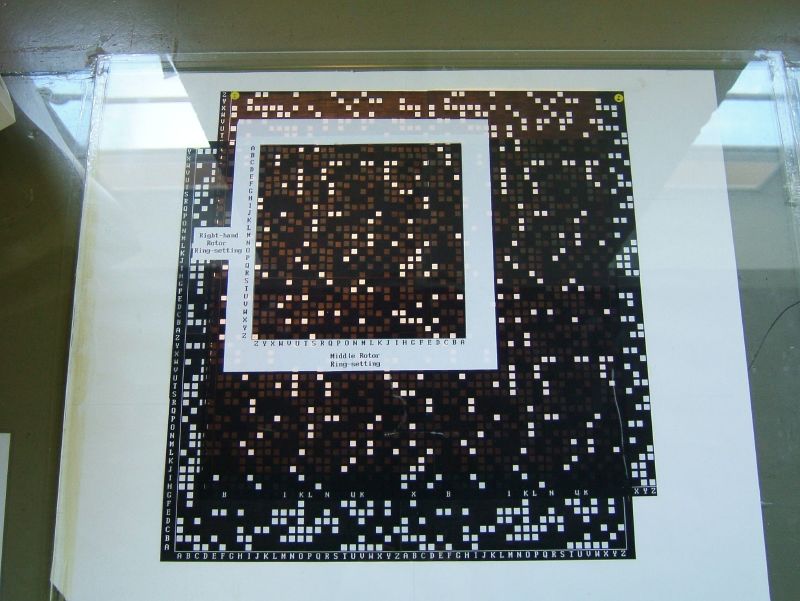
A Zygalski-sheet demonstration at Bletchley Park, photographed in 2004. These are modern demonstration sheets, not surviving originals from 1938.
Two more wheels
On Dec. 15, 1938, the German supply of cipher rotors expanded from three to five. An operator still installed three at a time. There were now five choices for the left position, four for the middle, and three for the right: 60 possible orders.
Covering those orders with one Bomba per order would require ten times the existing fleet. The mathematical weakness had not vanished, but the amount of equipment needed to search it had grown. Producing the corresponding sets of perforated sheets also demanded more work.
Plugboard practice complicated the task further. As more letters were exchanged by plugs, fewer remained unchanged. A search that depended on selecting an unchanged repeated letter had fewer suitable inputs. Several changes could therefore burden the Polish methods without changing the alphabet or the familiar appearance of an intercepted header.
The new wheels’ wiring could itself be recovered. Possessing that wiring did not pay for additional motors or complete every new sheet. Rejewski later objected to accounts that treated the Polish decision to share their work as the simple result of an insoluble technical failure.
In 1939, Germany’s military pressure on Poland gave the exchange of intelligence a more immediate setting. The Polish service held reconstructed machines and methods that its prospective wartime partners had not yet reproduced. Sharing them could move work beyond the equipment and staff available in Warsaw.
A meeting near Warsaw
In late July 1939, British and French representatives met the Polish cryptanalysts near Warsaw. The British delegation included Alastair Denniston, head of the Government Code and Cypher School, and the experienced cryptanalyst Dillwyn Knox. Bertrand represented the French intelligence connection that had helped supply the earlier documents.
The Polish team disclosed the reconstructed military Enigma and the methods developed against its traffic. Their visitors learned how far the work had progressed since 1932. Reconstructed machines were subsequently made available to Britain and France, carrying the Polish electrical solution into the allies’ own work.
This disclosure came before the German invasion. It put knowledge outside Poland while the Polish service could still explain what its machines and records meant. A set of rotor wirings alone would have left many practical questions unanswered. The visitors received methods developed through years of work on actual traffic.
Within weeks, the reconstructed Enigmas and the people who understood them would face different journeys. The machines could be handed over through the allied services. Evacuating the cryptanalysts depended on the course of a war that had not yet begun.
Work carried into wartime
Germany invaded Poland on Sept. 1, 1939. During the evacuation, the Cipher Bureau destroyed most of its equipment and many files to prevent their capture. Rejewski later recorded that destruction alongside the July disclosure. Knowledge had already crossed the border, although much of the apparatus that had produced it would not survive.
The Polish cryptanalysts continued their Enigma work in France. In January 1940, Alan Turing visited them there. GCHQ identifies his conversations with Rejewski as an important part of the exchanges that preceded the first British Bombe. Cooperation continued after the original Polish workplace had been lost.
Turing’s British machine attacked a different kind of evidence. Analysts used a likely piece of plaintext, called a crib, and tested its possible alignment with ciphertext. Gordon Welchman’s diagonal board later made the electrical rejection of impossible settings more effective. The British Bombe inherited knowledge made available by the Poles while applying a different search procedure.
The first British Bombe, Victory, arrived at Bletchley Park in March 1940. Its development required engineering as well as cryptanalytic reasoning, followed by operators who set up tests and checked the resulting stops. Knowing that an Enigma attack was possible did not remove the daily need to obtain a usable key.
In May 1940, the German Army and Air Force abandoned the doubled message key on most of their networks. The timing and procedures differed between networks. The repeated entry on which the Polish Bomba had depended disappeared from those headers. British Bombe work could continue with cribs, while each new key still had to be recovered from the traffic reaching the interceptors.